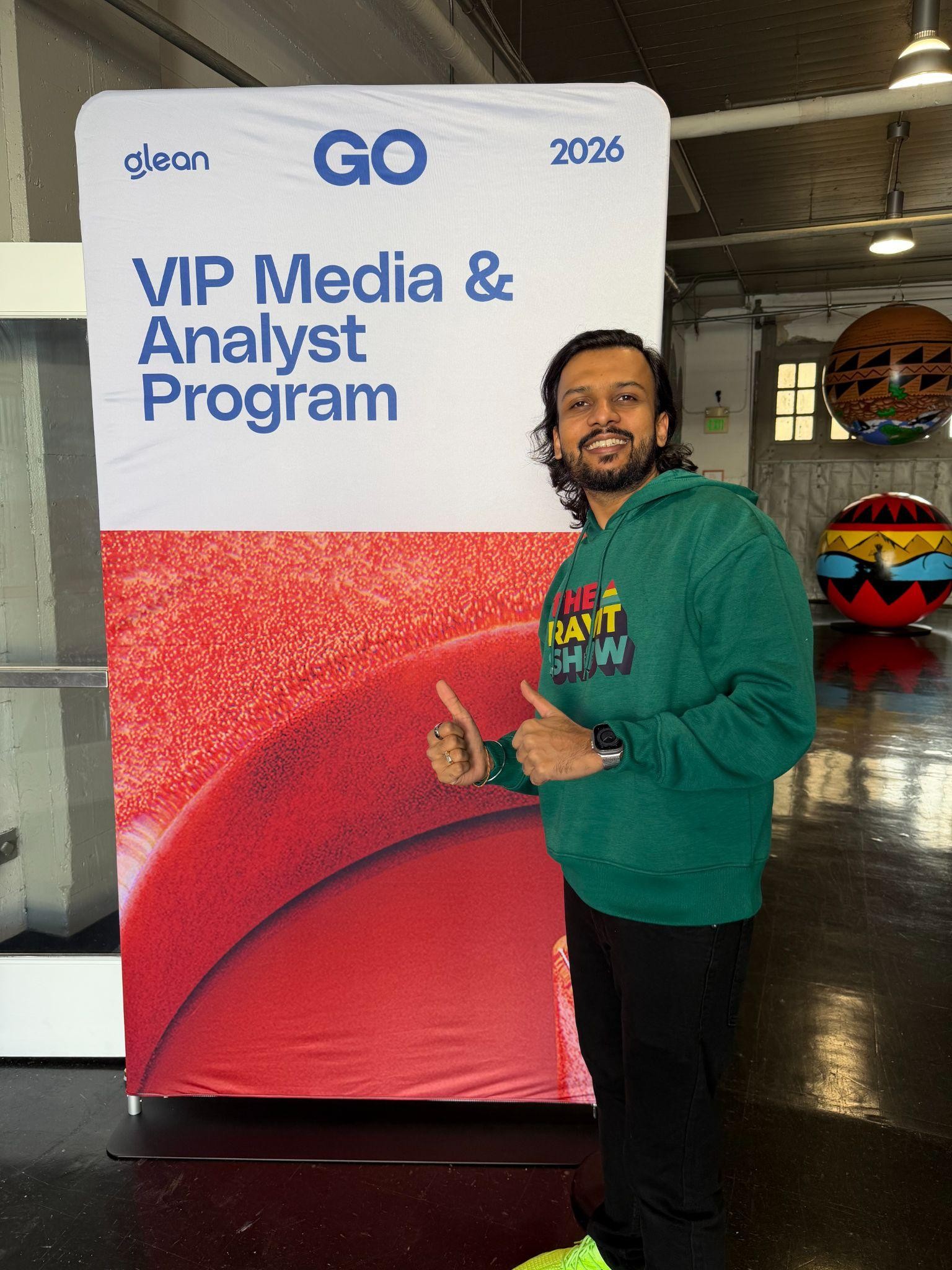
 Glean:GO 2026. Fort Mason, San Francisco, August 26 to 27. Image credit: Glean.
Reporting live from Fort Mason, San Francisco. By Ravit Jain, Founder and Host, The Ravit Show.
I am on the ground at Glean:GO 2026 at Fort Mason in San Francisco, and I want to start with the thing that struck me first.
Every enterprise AI vendor on the planet is currently telling you their model is smarter. Glean walked on stage and argued the opposite. Models are converging. What is not converging is whether the AI actually understands your company.
I got an early look at a lot of this during the VIP analyst and media session on day 1, before the keynote, and I will be honest with you. It is rare that a briefing changes how I frame a category. This one did. The room was not talking about benchmarks on reasoning. It was talking about cost per task, permissions, and who is responsible when an agent does something it was technically allowed to do.
Here is the full breakdown of what Glean announced today, and what I think it means for data and AI leaders.
1. The problem Glean named: botsitting
Glean gave the industry a word for something everyone has been quietly doing. Botsitting.
It is the time you spend babysitting an AI before it can do anything useful. Finding the right files. Pasting in background. Connecting the tool. Correcting it. Steering it through every step. You did not delegate the work. You just added a coworker who needs onboarding every single morning.
The argument Glean made in the analyst session is that botsitting is not a model problem. It is a context problem. A model that does not know your customers, your renewal cycle, your naming conventions, or who owns what is going to need hand holding no matter how good its reasoning is.
That framing sits underneath every announcement below.
2. Glean Tau: the desktop becomes the workspace
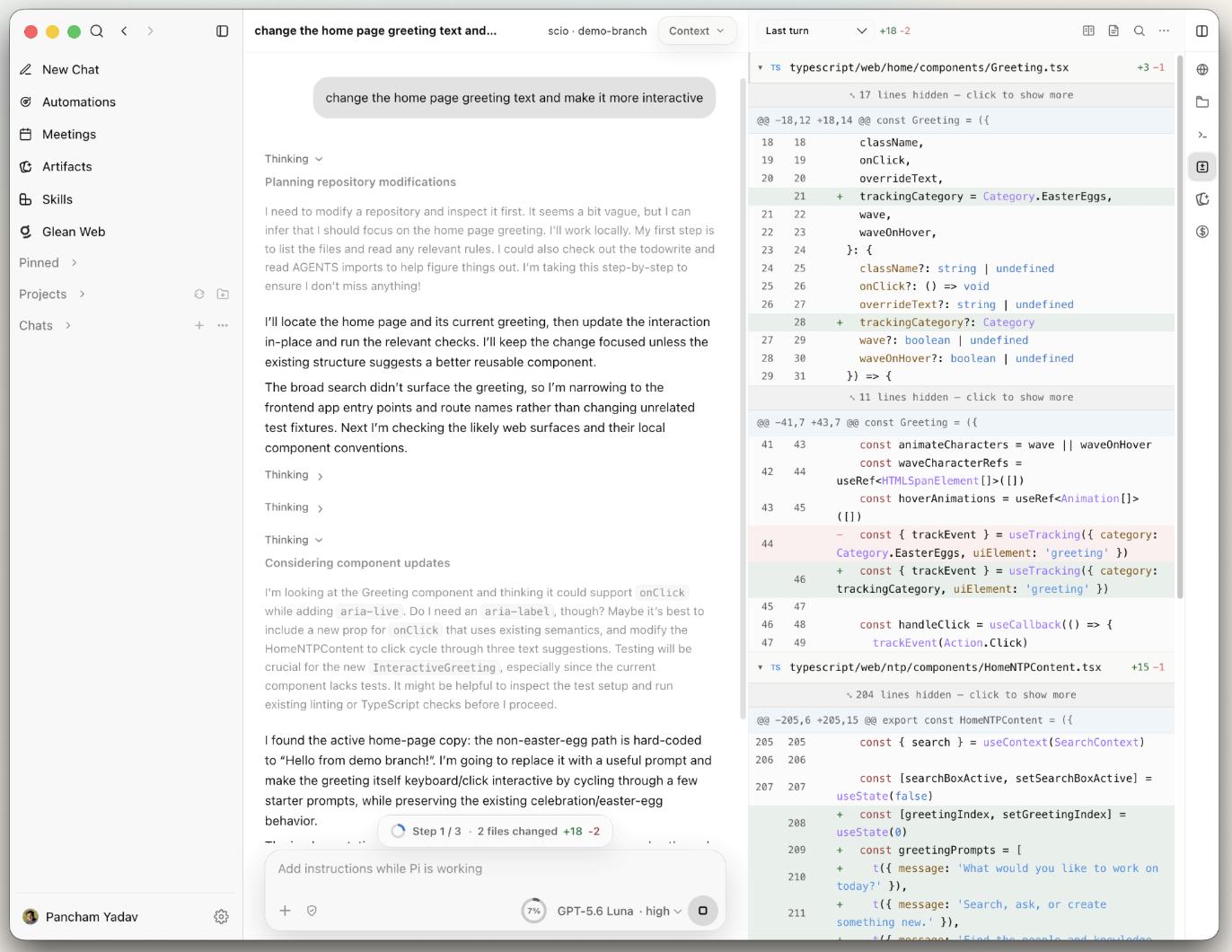 Glean Tau in action. This is the screen that got the loudest reaction in the room on day 1.
The headline launch is Glean Tau, a new AI desktop workspace built on an open source harness.
What makes it different from the assistant you already know: Tau reaches past the browser. It combines Glean's enterprise context with the files, applications, and code sitting locally on your machine, plus the latest models.
Glean says Tau can plan, execute, review, recover, and act on your behalf. That word "recover" is the one I would circle. Planning and executing is table stakes in agent demos. Recovering from a failed step without a human tapping it on the shoulder is where most agentic demos quietly break.
Use cases Glean showed: organizing files, analyzing documents, building spreadsheets, and working across connected apps. Coding and engineering workflows are an early use case, but the company was clear that Tau is not a developer tool. It is aimed at the whole enterprise, with governance, security, and cost controls carried in from the platform.
Tau is listed as coming soon.
My take: the desktop is the last unindexed frontier. Every serious enterprise AI platform has spent 3 years mastering SaaS connectors while the actual work sat in a folder on someone's laptop. Whoever closes that gap safely picks up an enormous amount of real context. The security review on this one is going to be intense, and it should be.
3. Glean Intelligence: model choice becomes a budget decision
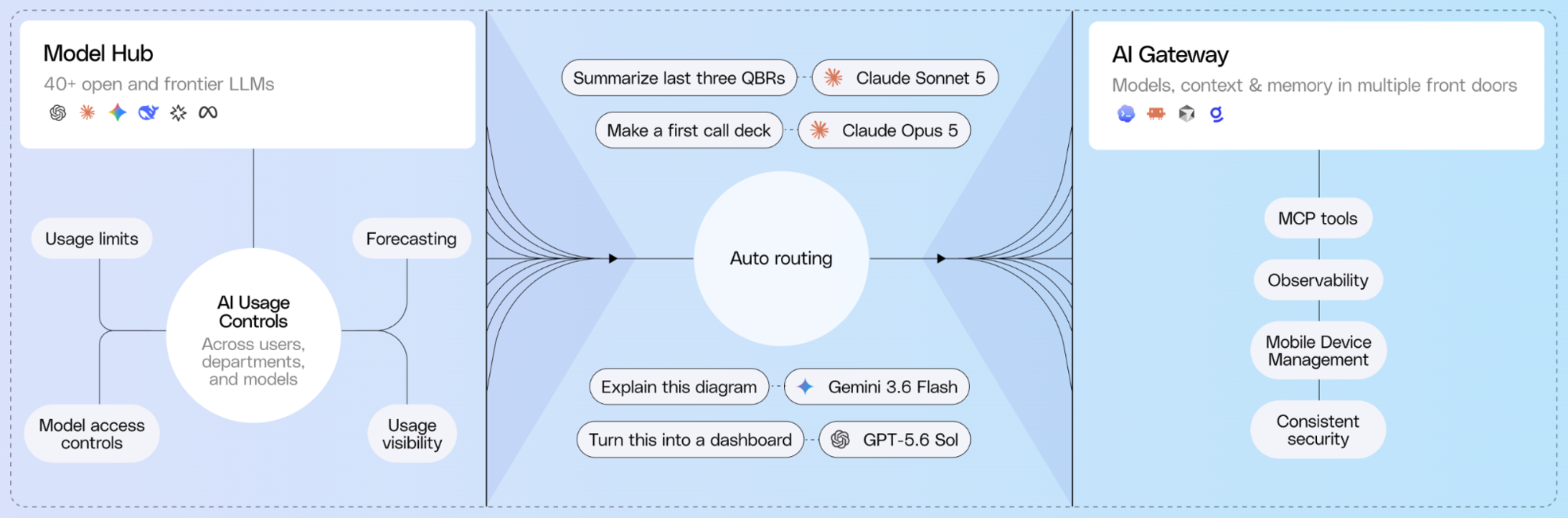 Model Hub on the left, auto routing in the middle, AI Gateway on the right. This single diagram is the clearest explanation of Glean's strategy I have seen.
This is the part that data leaders should read twice.
Glean expanded Glean Intelligence with centralized usage visibility and AI usage controls, plus enhanced auto routing that lets administrators prioritize efficient, balanced, or frontier models based on price and performance tradeoffs.
Read that again. An administrator can now set a policy that says: route this class of knowledge work to the cheap capable model, reserve the frontier model for the work that actually changes the outcome.
The Model Hub carries 40 plus open and frontier models. Usage controls cover limits, forecasting, model access controls, and spend visibility across users, departments, and models.
My take: for 2 years we benchmarked intelligence. In 2026 we are benchmarking harnesses and routing. Model selection has moved from an engineering preference to a line item that a CFO can see. That is a real shift, and most enterprises are not organizationally ready for it.
4. Glean Transform: find the work AI should actually do
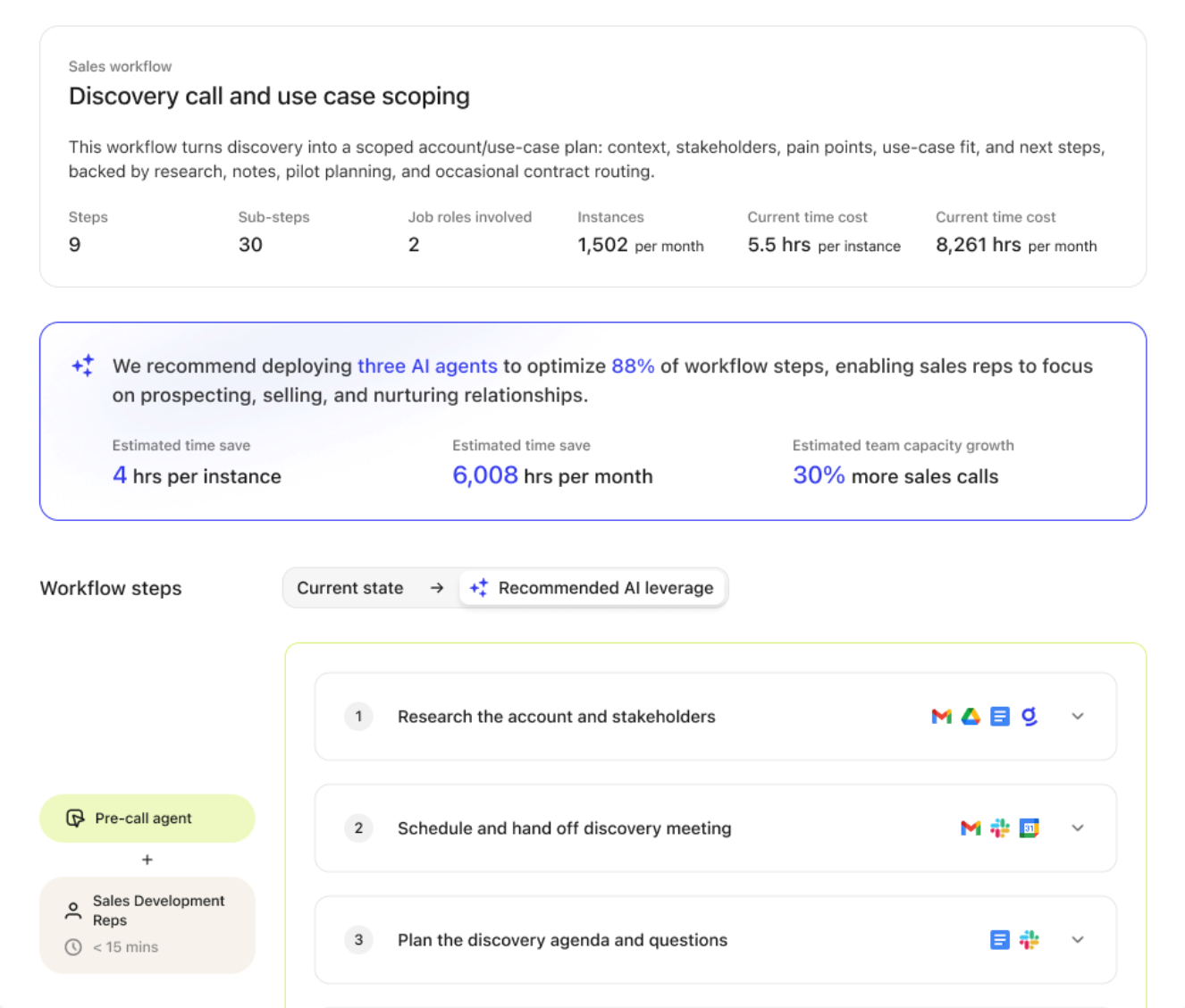 Glean Transform breaking down a sales discovery workflow into 9 steps and 30 sub steps, then recommending where agents fit.
This was my favorite demo of day 1, and I do not think it will get the attention it deserves.
Glean Transform uses real activity signals to understand how work actually happens inside your company. Not how the process document says it happens. How it actually happens. It then identifies the best split between people and AI, recommends where AI should take on work, connects those opportunities to specific skills and agents, and measures business impact.
The example on screen was a sales discovery and use case scoping workflow. 9 steps. 30 sub steps. 2 job roles. 1,502 instances per month at 5.5 hours each, which is 8,261 hours a month of human time. The recommendation was 3 agents covering 88 percent of the workflow steps, with an estimated 4 hours saved per instance and 6,008 hours saved per month.
My take: almost every AI transformation program I have covered in the last 18 months failed at the same step. Nobody could point to which process to automate first, or prove the value after. Transform is Glean pointing a product at the boardroom question. If the activity signals are accurate, this is a genuinely different way to build an AI roadmap. If they are not, it is a very confident spreadsheet. That is the thing to pressure test in your evaluation.
Transform is listed as coming soon.
5. Proactive AI: work that moves before you ask
Glean is extending its assistant to act on context without waiting for a prompt.
Proactive task management and coordination uses enterprise context to figure out what needs attention, identify next steps, and move work forward. Drafting a follow up. Preparing for a meeting. Email triage brings company context into the inbox to prioritize what matters and prepare responses. Independent agents will extend this to longer running work.
There is also a meeting coach in the coming soon list, which I want to see more of.
My take: proactive is the hardest product bet on this list. Get it right and it feels like a chief of staff. Get it slightly wrong and it feels like an assistant that will not stop talking. The difference between those two outcomes is entirely context quality, which is exactly Glean's argument.
6. Team chat: AI stops being a solo activity
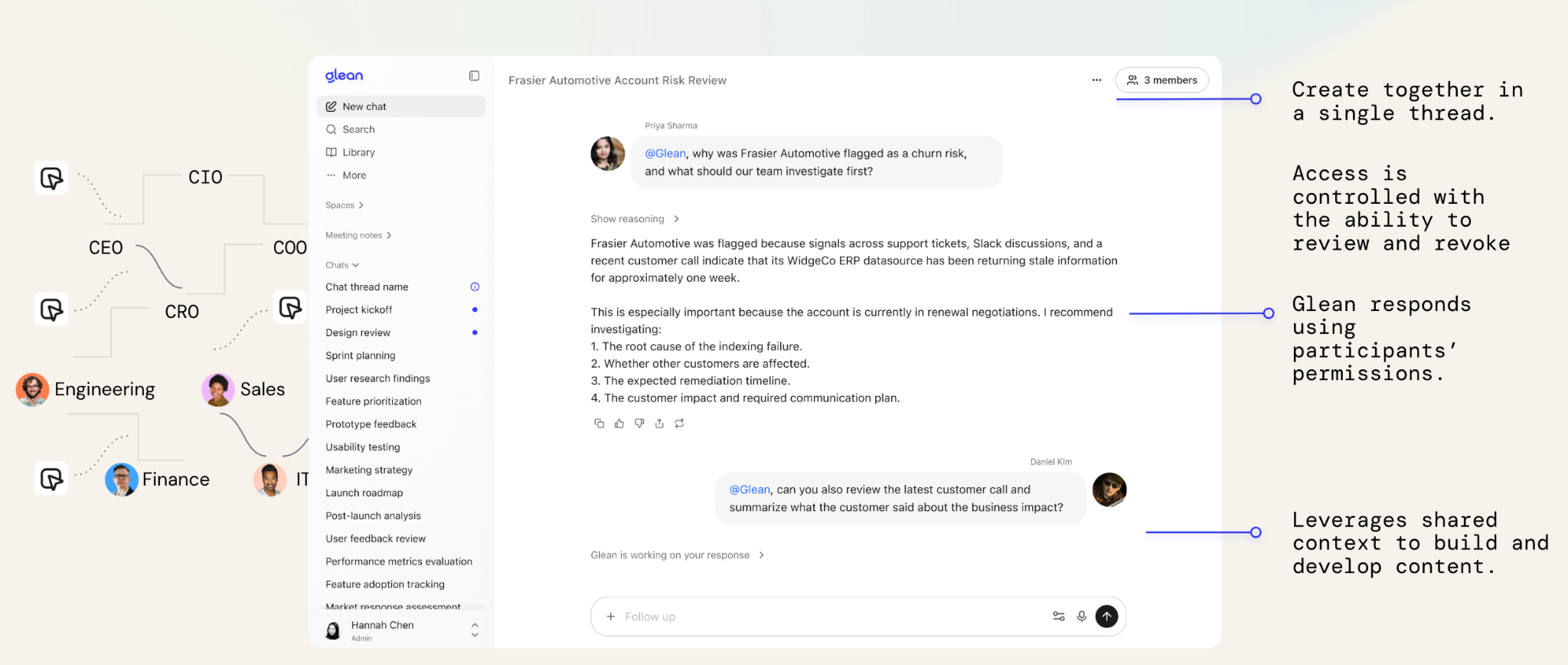 Multiplayer in a single thread, with Glean responding using each participant's own permissions.
This is deceptively important.
New team chat lets multiple teammates work with Glean together in the same shared thread or interactive artifact. Everyone contributes. The assistant builds on the shared context.
The detail I care about most: Glean responds using participants' permissions. Access is controlled, reviewable, and revocable. That means a finance person and an engineer in the same thread do not automatically see each other's restricted data through the AI.
Solving multiplayer AI without collapsing the permission model is a hard problem, and most tools have avoided it by simply not offering shared threads at all.
My take: enterprise work is not a single person prompting in a private window. It is 4 people arguing in a thread. Whoever makes AI work natively in that setting wins a lot of daily usage.
7. Interactive dashboards
Glean is expanding interactive dashboards that combine structured data with unstructured business context. Tickets, conversations, documents. The dashboards refresh as the underlying information changes and proactively surface the context a team needs to decide.
This is the piece that most directly overlaps with the BI world, and I expect it to generate the most debate in my community. A dashboard that explains why the number moved, using the Slack thread and the support ticket behind it, is a different object than a chart.
Dashboards, live and scheduled refresh, are in beta.
8. Governance: AI Gateway and context aware threat detection
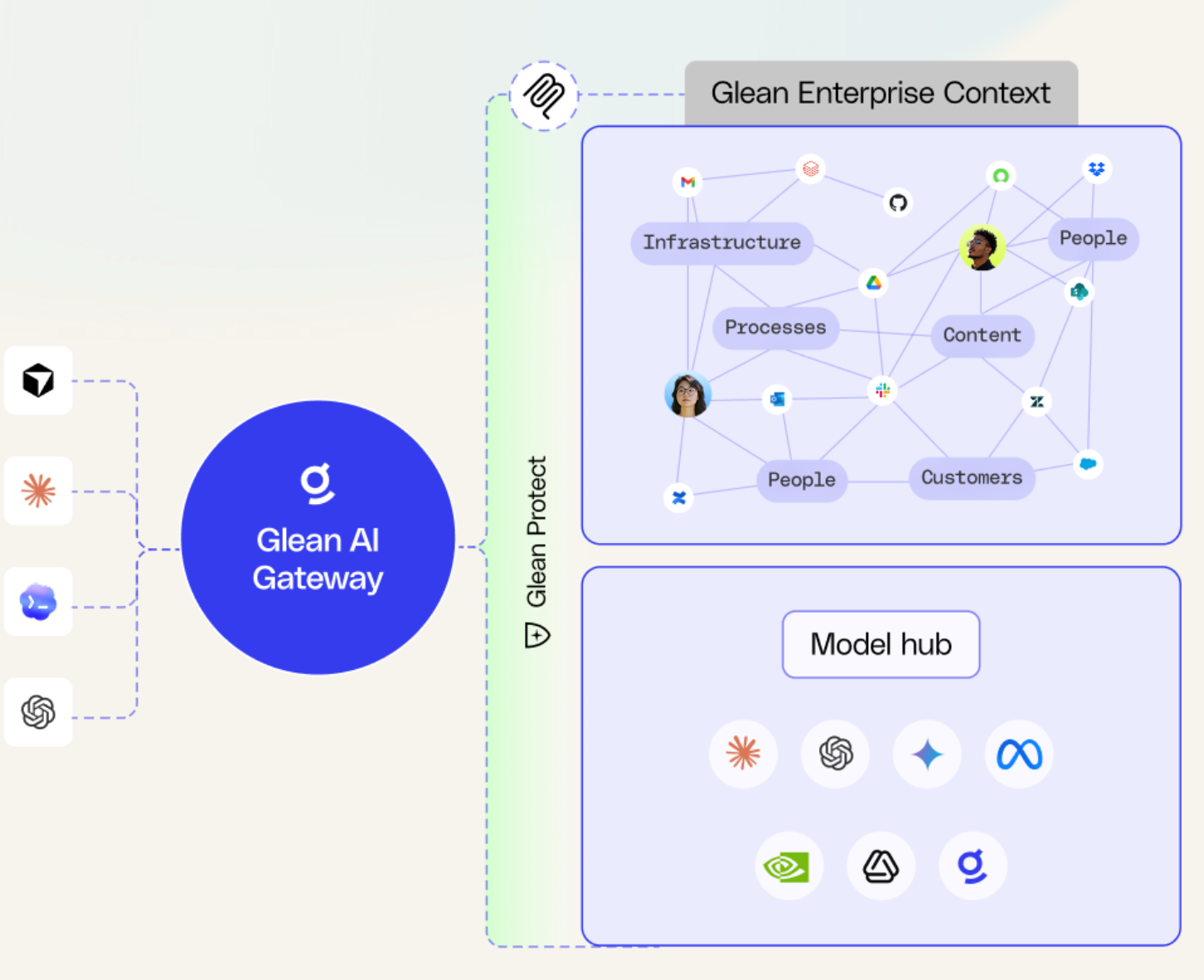 The architecture. Multiple front doors on the left, Glean Protect in the middle, Enterprise Context and Model Hub on the right.
AI sprawl is real. Every enterprise I speak to has more models, more agents, and more entry points than their security team can name.
Glean expanded its AI Gateway to support more AI entry points, enforce restricted topic policies through Glean Protect, and extend governed MCP access beyond enterprise context to include organizational skills and personal memory.
The one that made the analyst room go quiet was context aware AI threat detection. Glean uses signals from its Enterprise Graph, including who is acting, what data is involved, and the sequence of actions, to separate legitimate agentic activity from data harvesting, exfiltration, or destructive behavior.
The critical phrase: this includes cases where each individual action may be permitted, but the combined pattern signals risk.
My take: this is the most underrated announcement of the day. Traditional access control asks "is this user allowed to do this." Agentic security has to ask "does this sequence of 40 permitted actions add up to something nobody would approve." That is a graph problem, not a permissions problem, and it explains why Glean thinks the index is a security asset and not just a search asset.
What is available when
- • Generally available: Glean Intelligence, AI usage controls, memory via MCP
- • Beta: independent agents, AI gateway, auto routing, team chat, interactive dashboards with live and scheduled refresh
- • Coming soon: Glean Tau, Glean Transform, context aware threat detection, task management, meeting coach, email triage, skills via MCP
Be realistic about that third list when you build your 2026 plan.
The quote that framed the whole day
Emrecan Dogan, Chief Product Officer at Glean, put the thesis in 12 words: "Models are getting better and more interchangeable. Understanding the enterprise is not."
He went on to make the point that as AI moves from answering questions to doing work, company context becomes more valuable, because context is what tells the AI what matters, what should happen next, and how to act within the realities of the business.
Customers echoed the governance angle. Rhonda Baldwin, CIO at LaunchDarkly, described being able to scale AI safely because teams get control, trusted context, and multi model choice without giving up governance. David Lee at LegalZoom made the economic version of the same point, noting that recreating that depth of context on another platform would burn an enormous number of tokens, while Glean's index is already loaded.
That last comment is the bridge to the benchmark Glean published today, which I have covered in a separate piece.
My honest read as an analyst
Three things I believe after day 1.
One. The center of gravity in enterprise AI has moved from model quality to context quality and unit economics. Every vendor will be making this argument within 6 months. Glean made it first and shipped product against it.
Two. The desktop move with Tau is the aggressive bet. It expands what the AI can see and simultaneously expands the surface a CISO has to sign off on. Watch how enterprise security teams respond over the next 2 quarters. That reaction, more than any demo, decides whether Tau lands.
Three. Coming soon is doing a lot of work in this announcement. Tau, Transform, threat detection, and email triage are the 4 most strategically interesting items and all 4 are unreleased. That is normal for a flagship conference. It is also the right question to ask your account team.
If you are building your enterprise AI architecture in 2026, the practical takeaway is this. Stop evaluating assistants on demo quality. Evaluate them on 3 things. What context can it reach. What does one completed task cost. Who can see and revoke what it did.
I am here at Glean:GO through day 2 and will be bringing you conversations with the leaders behind these launches on The Ravit Show.
Sources and further reading
- • Glean press release: Glean Takes on Enterprise AI's Biggest Bottlenecks
- • Glean blog: The intelligence era is here
- • Glean benchmark: Glean vs Claude Cowork
- • Glean also announced its Global Partner Network
- • Glean Enterprise Context and Agent Builder
- • The Work AI Index 2026