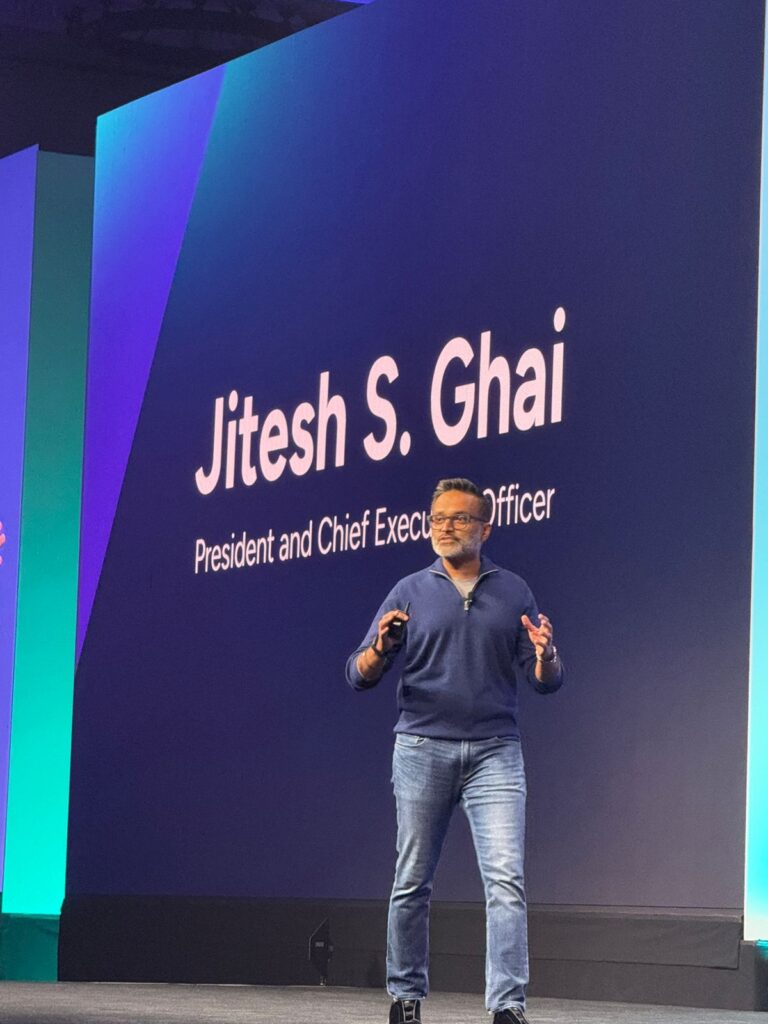
At CommunityLIVE, Hyland’s CEO Jitesh Ghai reframed the AI conversation with a powerful and relatable analogy: electricity. For centuries, electricity was known, studied, and partially harnessed, but it only transformed humanity when Nikola Tesla’s alternating current made long-range distribution possible. Once electricity became ubiquitous, it changed everything,industries evolved, societies reorganized, and innovation flourished.
Jitesh argued that artificial intelligence is at a similar inflection point today. Decades of research and incremental progress have brought us here, but the convergence of large transformer models, agentic AI, and enterprise-grade integration is ushering in an era of ubiquitous intelligence and automation. He emphasized that this shift will not only redefine how enterprises operate but also transform how we live, work, learn, and interact with the organizations that serve us.
The Announcements
Enterprise Context Engine
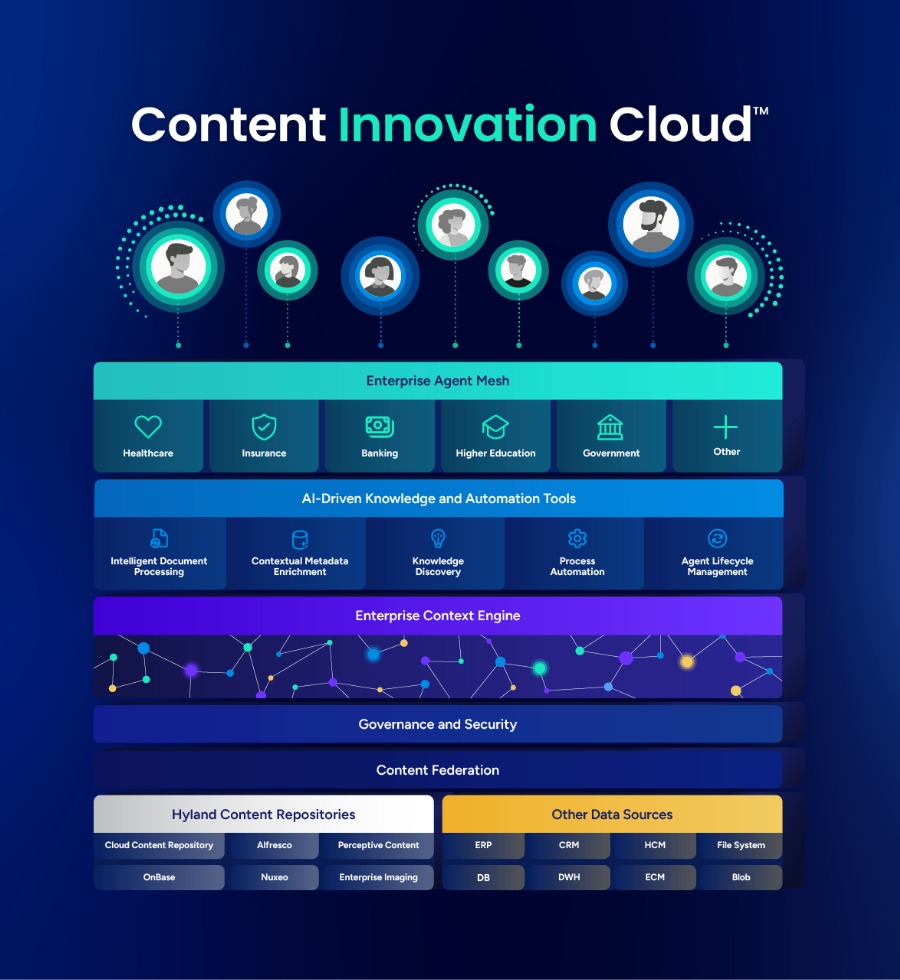
Hyland introduced the Enterprise Context Engine as a foundational layer of enterprise intelligence. It acts as a ‘living record’ of the enterprise, connecting people, processes, content, and applications across ERP, CRM, EHR, and more. Unlike siloed systems of the past, it creates a continuously updated, real-time contextual understanding of organizational operations. This means decision-makers can rely on a holistic and dynamic view of their enterprise, rather than piecemeal insights.
“It’s a connected and contextual understanding of your organization… a living record in real time.” – Jitesh Ghai
Enterprise Agent Mesh
The second major announcement was the Enterprise Agent Mesh, a multi-agent system designed to build on the Context Engine. Tailored for industries such as healthcare, banking, insurance, government, and higher education, it allows AI agents to coordinate, decide, and act across complex workflows. Unlike point solutions, this mesh is elastic, interoperable, and governed. By keeping transparency and security at the core, Hyland is ensuring enterprises can trust the agents’ decisions while scaling automation.
“It’s not about replacing people. It’s about delivering ubiquitous enterprise intelligence and automation, helping organizations fully automate routine tasks and enabling people to focus on the highest-value work.” – Jitesh Ghai
Why It Matters
Despite significant investment in AI, over $40B in GenAI projects, most enterprises still fail to see value. Ghai cited a striking statistic: 95% of enterprise AI projects fail. The reasons are clear: fragmented content, siloed data, disconnected applications, and workflows that lack alignment with AI tools. These challenges prevent organizations from achieving workflow fit, making it difficult for AI to generate meaningful outcomes.
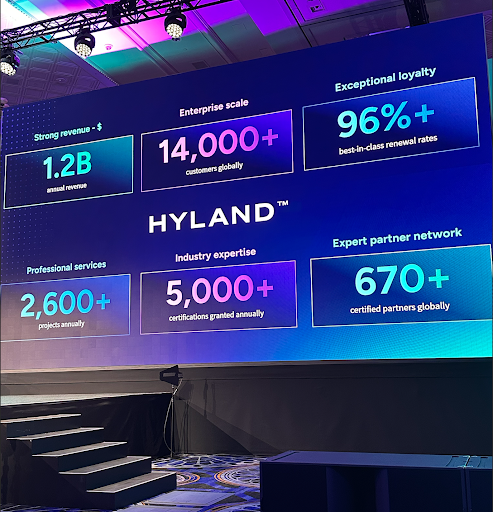
Hyland’s approach addresses this head-on. Instead of forcing organizations to rebuild their infrastructure, Hyland is embedding AI into existing systems, processes, and applications. This pragmatic strategy lowers adoption barriers and ensures that enterprises can leverage AI without losing continuity. Governance, security, and transparency are emphasized, aligning with Hyland’s role as a trusted steward of mission-critical enterprise content for decades.
Live Proof Points
Hyland showcased the practicality of its vision with live demonstrations that underscored how AI can deliver tangible results today:
– Healthcare Claims Processing: The demo illustrated how Hyland’s Content Innovation Cloud could classify, separate, and extract information from millions of documents, including handwritten and multilingual forms. The AI agents reduced manual review workloads while maintaining explainability and trust.
– Unemployment Benefits Processing: Hyland demonstrated how its Agent Mesh and Context Engine transformed a complex government process. Instead of caseworkers spending days reviewing fragmented applications, agents completed the process in minutes, retrieving data from multiple systems, validating documents, checking eligibility, and even suggesting additional benefit programs. Humans were still in the loop, but their work shifted from manual verification to oversight and decision-making.
These live examples were not theoretical, they were production-ready systems that highlight Hyland’s ability to translate vision into reality.
Industry Relevance
Hyland’s strategy stands out because of its deep industry expertise. Having served highly regulated and mission-critical industries for decades,including healthcare, financial services, higher education, insurance, and government,the company understands the unique requirements of each sector. This industry depth allows Hyland to design solutions that meet regulatory standards, address domain-specific workflows, and align with customer realities.
By launching industry-specific Enterprise Agent Mesh offerings, Hyland is delivering more than technology,it’s delivering fit-for-purpose solutions. Healthcare, for example, requires HIPAA compliance and precision in handling patient data. Banking and insurance require auditability and strong governance. Higher education and government demand scalability and transparency. Hyland’s offerings are tailored to these distinct needs, ensuring AI adoption feels natural rather than forced.
Broader Implications
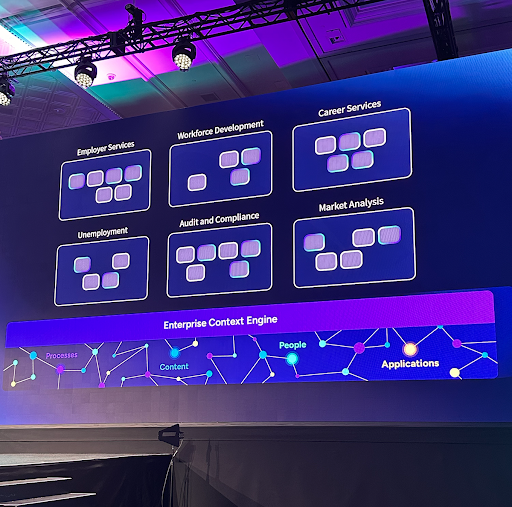
The announcements also have implications beyond technology. They suggest a future where enterprises operate with continuous, contextual intelligence. Employees will no longer spend hours searching for documents or reconciling data from fragmented systems. Instead, AI agents will surface the right insights at the right time, enabling people to focus on strategic work and human-centered outcomes.
This shift could redefine competitive advantage. Organizations that adopt AI-enabled, context-rich operations will be able to make faster, more informed decisions. They will deliver better customer experiences, improve compliance, and reduce operational costs,all while empowering their workforce. Hyland’s bet is that this future will be realized not by replacing humans, but by augmenting them with the infrastructure to scale intelligence across the enterprise.
My Take (Ravit Jain, Founder & Host of The Ravit Show)
Hyland’s announcements at CommunityLIVE reflect a balance of vision and pragmatism. The electricity analogy was not just memorable, it was apt. Just as electricity only transformed society when it became ubiquitous, trusted, and standardized, AI will only reshape enterprises once it is seamlessly embedded into workflows and governed at scale.
What stood out to me is the dual focus: delivering groundbreaking capabilities like the Enterprise Context Engine and Agent Mesh, while staying grounded in the realities of fragmented systems and complex industries. This makes Hyland’s approach credible and actionable.
Ultimately, Hyland is positioning itself not only as a vendor of enterprise software, but as the architect of the infrastructure layer for enterprise AI. If successful, the Context Engine and Agent Mesh could become the foundation on which organizations build the next decade of automation, intelligence, and human-AI collaboration.
Author
Ravit Jain, Founder & Host of The Ravit Show
Email – Ravit@theravitshow.com